
Joint research with Tokyo Women’s Medical University — a new non-invasive, radiation-free screening approach
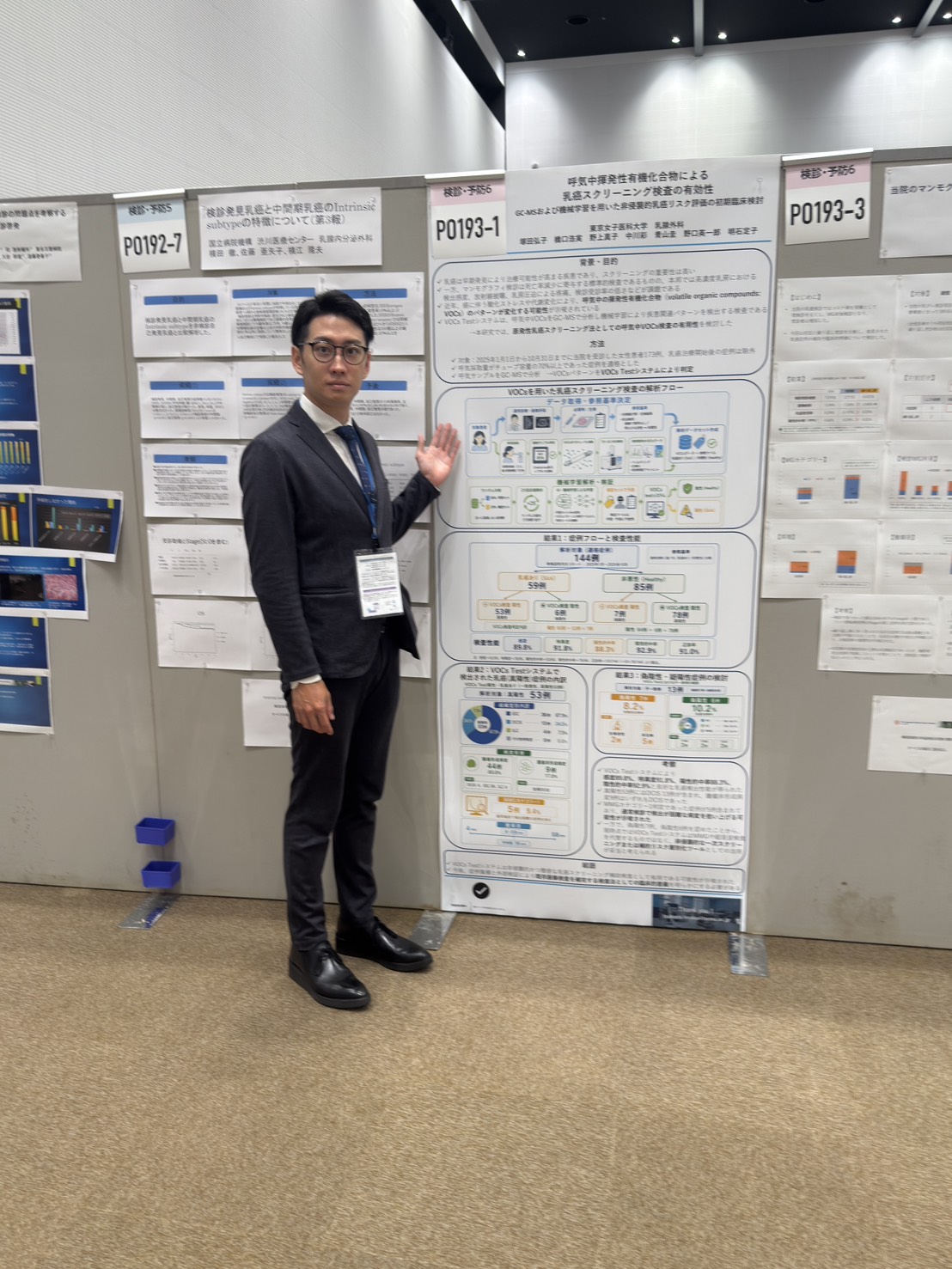
MediScan Co., Ltd. (headquarters: Chuo-ku, Tokyo), a Japanese medical technology startup, is pleased to announce that the results of a clinical study on breast cancer screening using volatile organic compounds (VOCs) in exhaled breath combined with AI were presented at the 34th Annual Meeting of the Japanese Breast Cancer Society, held from Thursday, June 25 to Saturday, June 27, 2026, at the Kyoto International Conference Center.
The study was conducted by the Department of Breast Surgical Oncology at Tokyo Women’s Medical University (Hiroko Tsukada, Hiromi Hashiguchi, Mako Nogami, Aya Nakagawa, Eiichiro Noguchi, Kei Aoyama, and Sadako Akashi), and was reported under the title “Effectiveness of Breast Cancer Screening Using Volatile Organic Compounds in Exhaled Breath: A Preliminary Clinical Study of Non-Invasive Breast Cancer Risk Assessment Using GC-MS and Machine Learning” (Abstract No. PO0193-1).
Background
Breast cancer is one of the cancers that can be treated when detected early, making screening particularly important. While mammography (MMG), the standard screening method, contributes to reducing mortality, it presents several challenges in Japan, including reduced detection sensitivity in dense breasts, radiation exposure, and pain associated with breast compression. These factors are cited as contributors to the country’s low screening participation rate. Against this backdrop, there is a growing need for simpler, non-invasive, and more accessible screening methods.
The test used in this study analyzes exhaled breath using gas chromatography–mass spectrometry (GC-MS) and detects disease-related patterns through machine learning.
Study Overview and Results
The study enrolled 173 female patients who visited Tokyo Women’s Medical University Hospital between January 1 and October 31, 2025 (cases already undergoing breast cancer treatment were excluded). Breath samples were analyzed by GC-MS, and results were determined using AI-based analysis.
The main results for the 144 eligible cases included in the analysis were as follows:
- Sensitivity: 89.8%
- Specificity: 91.8%
- Positive predictive value (PPV): 88.3%
- Negative predictive value (NPV): 92.9%
- Overall accuracy: 91.0%
The study also suggested that the breath test may help detect a portion of lesions that are difficult to identify through conventional screening (cases assessed as Category 1 on mammography).
Significance of the Study
This study indicates that breath-based testing may be useful as a supplementary method for breast cancer screening that is simple, non-invasive, and free from radiation exposure and pain. Going forward, further case accumulation and external validation will be needed to more fully evaluate the clinical significance of the test as a complement to existing imaging examinations.
Through the continued accumulation of such research, MediScan aims to make “non-invasive, accurate, and accessible testing” more widely available in society, contributing to the early detection of breast cancer and to people’s peace of mind.
About MediScan Co., Ltd.
MediScan is a medical technology startup working to realize “non-invasive, accurate, and accessible testing” through technology that uses AI to analyze components contained in exhaled breath. Its mission is to make testing that anyone can undergo without burden widely available in society, thereby contributing to the early detection of disease and to people’s peace of mind.
Related Links
Contact
MediScan Co., Ltd.
TEL: +81-3-6280-6895
E-mail: info@mediscan.co.jp